
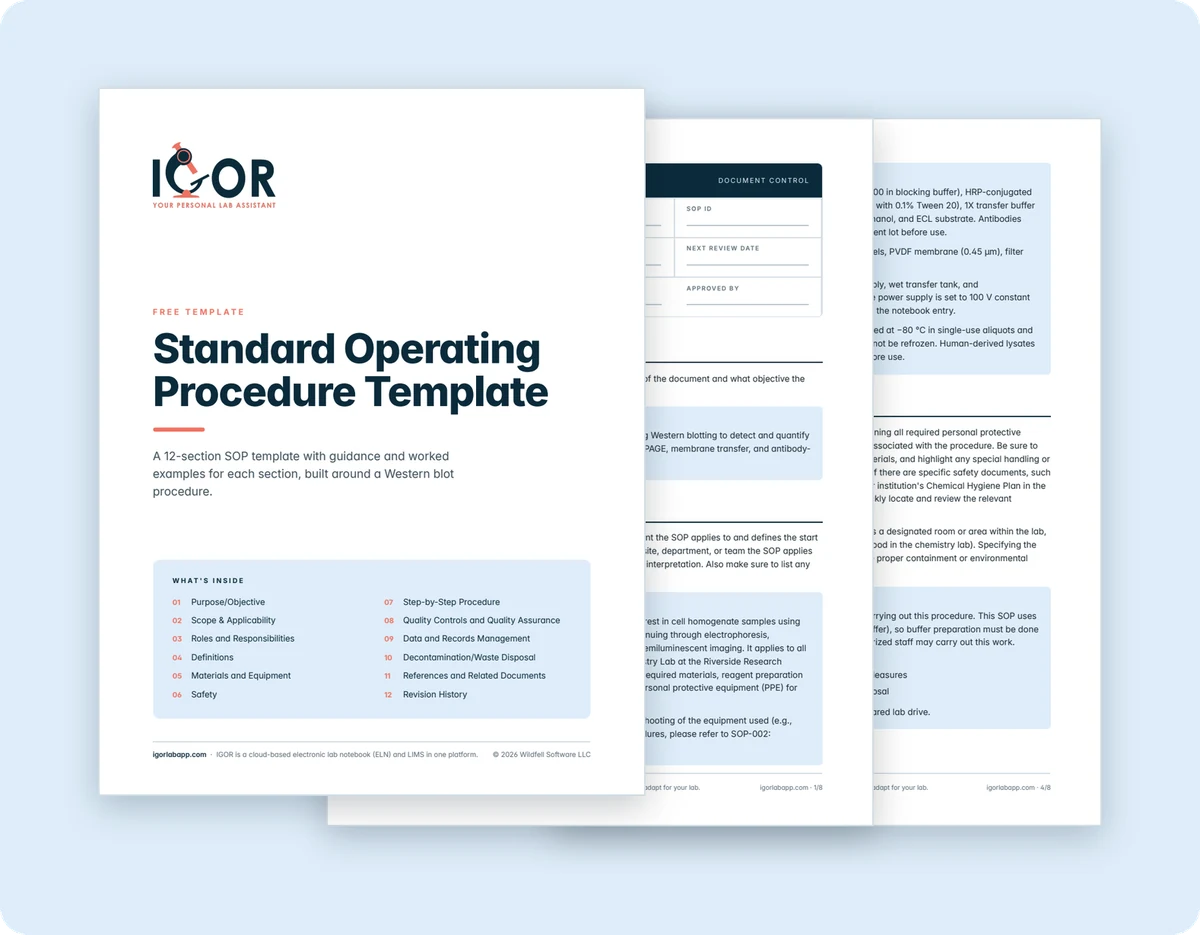
This free lab SOP template gives you 12 sections we think every standard operating procedure should include, ready to adapt to your own assay and lab. Each section explains what belongs there and shows a worked example from a Western blot SOP, so you can see what a finished section could look like.
Want to see SOP review and approval in IGOR? Book a personal demo.
What a good SOP needs, and how this template helps
The template opens with a document control block for the SOP title, ID, version, effective and review dates, author and approver. Then come 12 sections, each with guidance on what to include and an example from a Western blot SOP. Add sections of your own wherever your procedures need them.
What the SOP is for, in one or two sentences.
The exact procedure it covers, its start and end points, and who it applies to.
Who performs, reviews and approves it, and the training each role needs.
Technical terms and acronyms, listed alphabetically.
Reagents, consumables and equipment, with specifications and accepted alternatives, plus sample handling.
PPE, chemical and biological hazards, required training and special handling.
The method itself, in order, with enough detail to run it unsupervised.
Controls, calibration, acceptance criteria, corrective actions and how deviations are logged.
Where data are recorded and stored, and any calculations or analysis steps.
How to decontaminate equipment and dispose of hazardous materials and waste.
Equipment manuals, related SOPs and other documents the procedure depends on.
What changed, when, why and by whom, in a table.
This SOP template is a free resource from the IGOR team to help you write your lab’s own procedures. We cannot warrant that its content is accurate, current or complete, or that it meets the regulatory guidelines that apply to your work, so please check that it suits your lab’s requirements before you use it.
A standard operating procedure (SOP) is a written, step-by-step method for a routine lab procedure, approved before use, so the procedure runs the same way no matter who performs it. For a Western blot, that means the transfer runs at the same voltage, for the same time and at the same temperature, whoever sets it up.
A good SOP does more than list steps. It states what the procedure is for and where it applies, who performs, reviews and approves it, which reagents and equipment it needs, what the safety controls and acceptance criteria are, how data are recorded and how waste is handled. It also carries a version number and a revision history, so you can tell which version a given experiment followed.
For studies conducted under GLP (21 CFR Part 58 or OECD equivalents), written SOPs are a regulatory requirement. For other research, they're good practice: results are easier to reproduce, and a method stays intact when the person who wrote it moves on.
IGOR provides this same template when you create a new SOP in the app.
Read more about SOP management in IGOR. It's included in the Professional and Momentum plans.
In a personal demo, we walk you through writing, approving and attaching an SOP in IGOR using an example experiment.

“We can document experiments and SOPs quickly and with minimal effort, which has drastically cut down the time spent on administrative tasks and given us more time to focus on experiments and data analysis.”
John Curd, CEO, Peptimatrix Ltd
SOP Management
How to write, organize and manage lab SOPs, from first draft to review.
Read article ›

Lab Software Guides
How to move paper records and SOPs into an ELN or LIMS, from platform choice to go-live.
Read article ›
Research Workflows & Documentation
What to write in a lab notebook, and how to keep it organized and reproducible.
Read article ›
Lab Software Guides
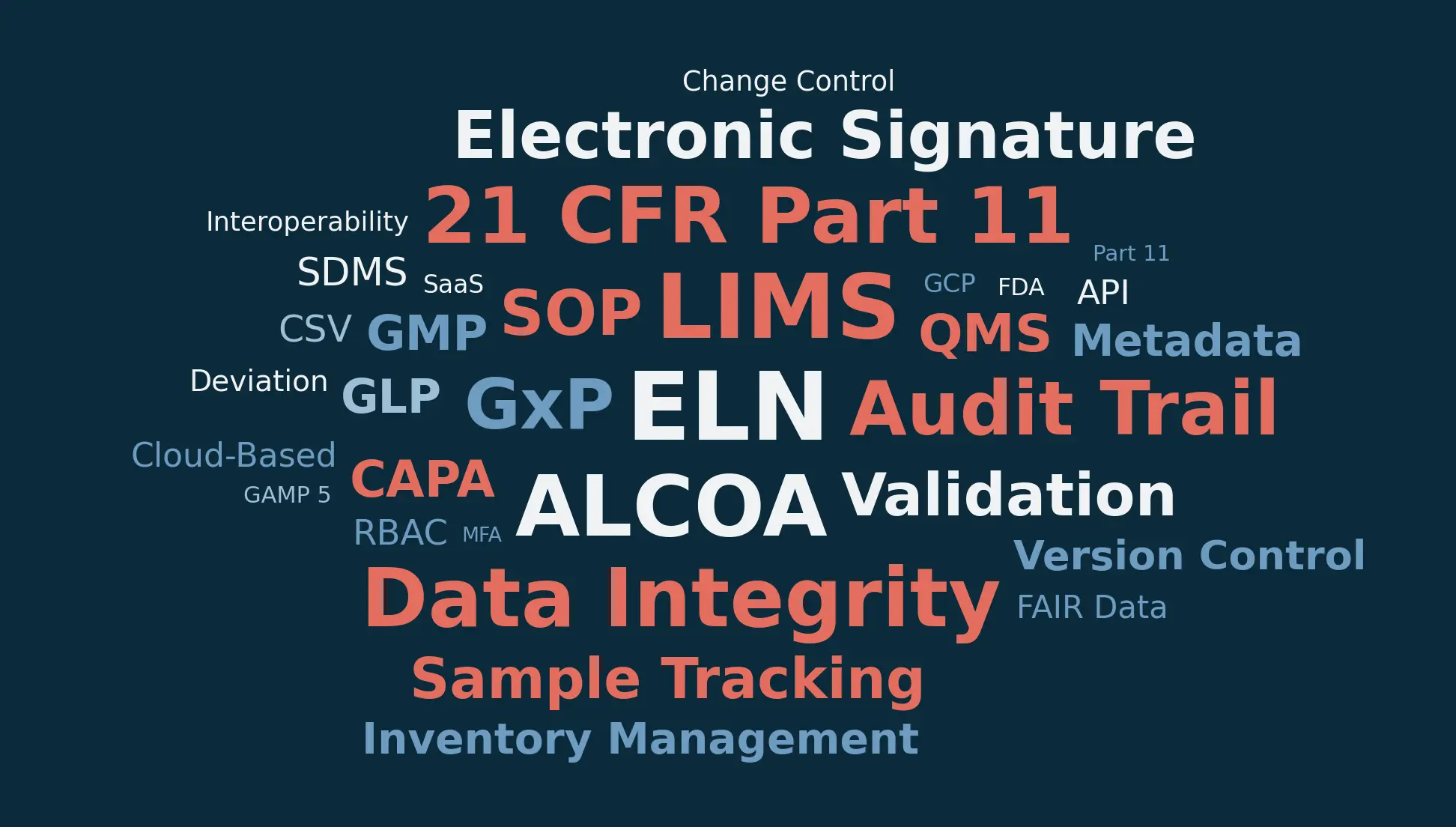
Plain definitions of 100+ ELN, LIMS and lab compliance terms.
Read article ›
Yes. IGOR’s lab SOP template is a free PDF download. Enter your name, work email, and company or institution in the form on this page, and the next page has the download. You don’t need an IGOR account to use the template, and the IGOR newsletter opt-in is optional.

Yes. The Western blot examples in IGOR’s SOP template show what each section looks like once it’s filled in, but the 12 sections apply to any routine lab procedure. The same structure works for an ELISA, a cell passage, an RNA extraction or an equipment calibration. For a simple procedure, some sections may need only a sentence or two. Add sections of your own wherever a procedure needs them.
An SOP describes a routine procedure that should run the same way every time, and it’s approved before anyone uses it. A protocol usually describes the method for one experiment or study, and it can change from one experiment to the next. Many labs use the two words loosely and call their SOPs protocols. The practical difference is control. An SOP carries a version number, a named approver, an effective date and a revision history, so you can tell which version a given experiment followed. Under GLP (21 CFR Part 58 or OECD equivalents), the study protocol is a separate document that sets out the objectives and design of one study, and it refers to the SOPs used to run it. In IGOR, SOPs are reviewed and approved with electronic signatures before use, and the method details of each experiment are recorded in its notebook entry.
In IGOR, an SOP sets out in detail how a procedure needs to be performed. An experiment template sets out what to record while the procedure is carried out. SOPs go through review and approval with electronic signatures before they can be issued to the team, in line with good practice and, for studies conducted under GLP, regulatory requirements. Experiment templates don’t need a formal approval process. A template can be divided into steps that follow the stages of the experiment, so everyone records the work in the same order and the record is easier to scan.
Give every SOP a review date and revise it whenever the procedure changes. IGOR’s SOP template has a review date in its document control block, next to the version and effective date. In IGOR, a revised SOP goes through review and approval with electronic signatures before anyone can use it, and the outdated version is archived so it stays out of circulation. Notebook entries keep the copy of the SOP that was attached to them, so each experiment still shows the version it followed.