
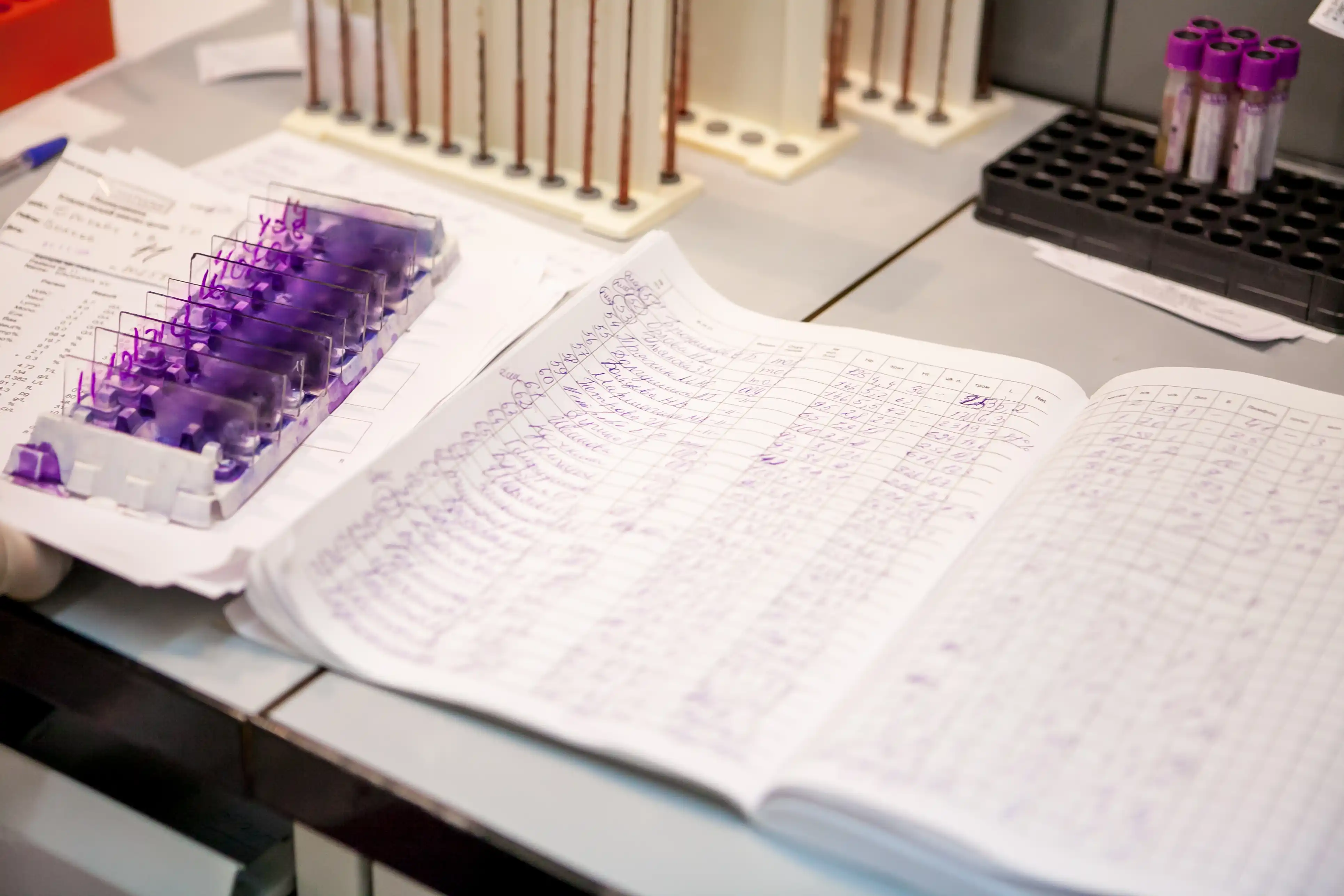
I worked at the bench in both academia and industry for over 12 years. I learned and performed many techniques, from immunogold staining for electron microscopy to molecular biology, chromosome spread analysis, live-cell imaging, Western blots, PCR, flow cytometry, multiplex cytokine assays, and more. Among the most important skills I developed during that time was keeping a reliable laboratory notebook.
This is completely underestimated by many scientists, especially in academia. I’ve worked with many scientists who struggled to keep their lab notebooks up to date - or, in some cases, didn’t bother keeping a lab notebook at all. And to be honest, for many years (before I transitioned into industry), my own “system” for documenting my research wasn’t that great either. I just didn’t know it at the time. I thought I had a great system.
But now, looking back a few years later and trying to piece together what I did, how I did it, what samples or reagents I used, and which files and analyses correspond to which notes and protocols, reconstructing the context of the data is far more time-consuming and difficult than it should be.

Your lab notebook is your scientific legacy in the lab. Others will build on the research you are doing now, and it is imperative that they can replicate what you have done. A proper notebook allows those who come after you to do that. A poorly kept notebook does not. Ultimately, your lab notebook is how you will be remembered during this time in your career.
The Reproducibility Problem
There’s a simple, uncomfortable truth in research: “If it is not documented, it didn’t happen.”
Meaning if experimental details aren’t recorded clearly and completely, they are effectively lost. Without documentation, even your own future self will struggle to repeat your experiment. And if you can’t reproduce your own results six months later, no one else will be able to either. That means reproducibility doesn’t begin at the moment someone attempts to repeat an experiment. It begins when the experiment is first documented.
Of course, not all reproducibility issues stem from documentation. Biology is messy. Model systems can be inherently variable (think tumor heterogeneity). And it is true - especially in early-stage discovery in biology - many breakthroughs begin as anomalous findings. But those are reproducibility issues that stem from biological, statistical, or operational factors. These kinds of variability are part of doing science and, at times, even scientifically valuable.
But irreproducibility caused by incomplete or inconsistent documentation is entirely different. That is not scientific complexity. It is a preventable breakdown in record-keeping, and one that directly undermines the credibility of the work.
There is no scientific value in this kind of irreproducibility, yet it remains widespread: A 2012 study reported that only 6 of 53 “landmark” preclinical oncology studies could be reproduced in industry settings [1]. That’s a meager 11%.
An eight-year collaboration led by the Center for Open Science and Science Exchange - the Reproducibility Project: Cancer Biology - aimed to independently replicate experiments from high-impact cancer biology studies published between 2010 and 2012. The project selected experiments from 53 influential papers and developed rigorous, peer-reviewed protocols to repeat them, with all methods and replication data made openly available.
Across the initiative, researchers ultimately attempted to repeat 50 experiments from 23 papers. What they found was concerning:
- Effect sizes were approximately 85% smaller on average than reported in the original publication.
- Only about 46% of effects replicated successfully on more criteria than they failed.
- Original positive results were less likely to replicate (≈40%) than original null results (≈80%).
The effort also highlighted practical challenges in replicating preclinical cancer research, including incomplete reporting of original methods, difficulty identifying and obtaining key reagents, and variability in original protocols.
Overall, the project provided systematic evidence that reproducibility in preclinical cancer biology is lower than expected, underscoring the need for better transparency, documentation, and research practices to support the reliability of published biomedical findings [2, 3, 4].
As a scientist, you need to ask yourself: If I can’t reproduce the results of a study, does it even count? The answer is: Probably not. Because scientists won’t trust your publications if they can’t reproduce your findings. Poor documentation has serious consequences for your credibility and reputation. And the scientific community will not build on research it does not trust.
You also need to consider the added scrutiny that has arisen from the introduction of AI. For a broader look at how documentation expectations are shifting, our blog post on Can You Use AI in the Lab? is worth a read.
In this post, I’ll walk you through lab notebook best practices, including what to include in your entries, how to stay organized, and common pitfalls to avoid.
What a Laboratory Notebook Is - and What It’s Not
A laboratory notebook is much more than a place to write down what you did on a given day. It’s a complete, chronological record of your experiment plans, methods, data, observations, and thought process - everything someone else would need to reproduce your work.
Your lab notebook should show:
- Why the experiment was done
- How it was performed
- What the results were
- Any deviations, observations, or unexpected outcomes
It is important to understand that your lab notebook is a legal document (which many scientists tend to forget as they doodle little cartoons in the corner of their notebook pages during lab meetings…).
If your data feed into a patent application or a submission to the FDA or another regulatory body, the notebook will be closely scrutinized because it documents your group’s claim to the discovery. If allegations of fraud are brought against your published work, your lab notebook will be used to validate your findings and defend your claims.
For that reason, adopting good practices early protects you, your group, and your scientific legacy.
What your Laboratory Notebook isn’t:
- A space for personal musings or brainstorming
- A chat log of conversations with your PI or lab mates
- A repository for copied protocols from supplier manuals (reference these externally instead)
Three Notebook Formats & What They Mean for You
There are three major ways to keep a lab notebook:
1. Bound or Stitched Notebooks
Traditional and trusted for legal integrity. Pages are pre-numbered and difficult to remove, making them strong evidence in disputes. However, they are harder to reorganize or copy, and bulky data must be stored elsewhere with references in the notebook.
2. Loose-Leaf or Three-Ring Binders
These make it easy to group entries by experiment and include bulky printouts or images next to relevant records. However, because sheets can be removed, authenticity is harder to verify.
3. Electronic Lab Notebooks (ELNs)
Electronic lab notebooks have become increasingly popular because they solve very practical problems. They make experimental records searchable, keep data in one place, and reduce the need to piece together context from paper notebooks, shared drives, and other data silos. You can quickly find past experiments, link supporting files, and see how protocols evolved over time.
Good ELN systems go a step further. Some, like IGOR, integrate lab inventory tracking and SOP management directly with the experimental record. That means reagents, lot numbers, protocols, and related experiments can all be linked and referenced within the same system. When someone needs to reproduce an experiment - or understand why a result looked the way it did - the relevant context is already connected rather than scattered across separate tools.
If you're unsure whether your lab needs an ELN, a LIMS, or both, our LIMS vs ELN guide breaks down the difference.
Your principal investigator (PI), QA manager, team lead, or operations manager will typically set standards for which format you use, but good documentation habits matter regardless of medium.
Core Components of Every Laboratory Notebook Entry
Whether pen-and-paper or digital, every lab notebook entry should contain:
✅ Date & Title
Start with a clear date and a descriptive experiment title so entries are easy to reference.
✅ Objective or Hypothesis
Explain why you’re doing the experiment. There’s no need to write a novel, but provide essential background logic, relevant literature, prior experiments, or talks that inspired it.
✅ Detailed Protocol or Reference
This is one of the most important - and unfortunately most neglected - parts of a notebook entry. For other researchers to reproduce your results, you must provide a detailed protocol or reference a previously recorded method. Detailed is the key word here. I have often encountered protocols missing critical information, such as incubation times, temperatures, dilutions, centrifugation times, or speed.
A quick side note, because I’ve seen this done incorrectly many times: the correct way to document centrifugation speed is in RCF (relative centrifugal force), written as: 10,000 × g
Why? Because RPM depends on rotor radius, and different centrifuges (or even different rotors on the same centrifuge) produce different forces at the same RPM.
I know it can be tedious, but maintaining detailed, up-to-date protocols is essential in research. If your team runs any assay routinely, it really should write a Standard Operating Procedure for it. Our guide to mastering SOPs in the lab covers how to approach SOPs without it becoming a bureaucratic nightmare.
✅ Reagents, Equipment & Conditions
This is another vital part of your notebook entry that is often undervalued or overlooked. It is important to record specific details about the reagents and samples used.
For example, writing “samples were incubated in Caspase-3 primary antibody diluted 1:1,000 overnight at 4°C” might seem sufficient at first glance. It tells me the antibody, dilution, temperature, and time. However, there are dozens - if not hundreds - of distinct Caspase-3 antibody products listed across many suppliers. Without knowing the supplier, catalog number, and lot number, I would never be able to repeat that experiment with confidence.
Therefore, it is vital to record:
- Chemical/reagent source, supplier, catalog number, lot number, and expiration date
- How solutions were prepared (e.g., dilutions and stock sources). Also write down any calculations.
- Cell line details (source, passage number, culture medium used, additives)
- Details of any other biological system or component used
- Equipment make, model, and serial number
The more detail you provide, the easier reproducibility becomes.
If your work involves human tissue samples or biospecimens, there may be additional information and details that you need to document and track. Our guide to managing biospecimen inventory covers this in more detail.
Observations, Data & Unexpected Turns
The most exciting part - and for many, the heart of the entry - is your observations. This includes:
- All measurements, readings, and other observations (numeric or qualitative)
- Any deviations from your protocol, whether planned or accidental
- Errors and mistakes (yes, it’s important to include these as well! Mistakes happen to all of us. Don't beat yourself up over it, just make sure to record it.)
- Raw data entries or references to where data are stored
If you generate printouts, handwritten notes, or external data files, tape them in, link them to your ELN, or clearly reference their location. If using IGOR, you can simply use the companion ELN mobile app to snap a picture of your hand-written notes and send them straight to the relevant notebook entry in the ELN.
Once data are processed or graphically analyzed, record exactly how you processed or analyzed them and which software (including version number) or scripts you used. And always include next steps at the end of the entry. Your future self will thank you.
Organization: Table of Contents & Entries
If you’re using a paper notebook, maintain a running table of contents at the front. For each entry, record:
- Date
- Experiment title
- Location (page number or digital link)
This simple habit makes your notebook easy to navigate - not just for you, but for others who may rely on your work in the future. Some ELNs, like IGOR, do this for you automatically.
Lab Notebook Best Practices for Ethics & Data Integrity
Good documentation isn’t just about clarity - it’s about honesty and reproducibility. Here are a few golden rules:
- Record all data, even negative or unclear results.
- Never remove pages from a bound notebook.
- Cross out unused spaces in a way that prevents later additions.
- Correct mistakes with a single line; sign and date corrections.
- Have a qualified team member review and witness your notebook entries. This is good practice in general to improve transparency, accountability, and quality, but it is particularly important in industry settings, where your work may be used for regulatory filings or patent applications.
- If using a paper notebook, keep it at work. It belongs to your institution and should never leave the lab. You may make photocopies, but don’t take it home.
This rule is unfortunately often disregarded, especially in academia, where students take notebooks home to update them or while writing their thesis. This should not happen (imagine getting distracted and leaving it on the bus or train!). A cloud-based ELN avoids this risk by allowing access to your records when needed without physically transporting them.
Examples That Illustrate Good Entries
In professional practice, good lab notebook pages contain:
- Clear project titles
- Purpose or goal sections
- Detailed protocol and reagent information
- Raw data entries and labels
- Follow-up notes and protocol adjustments
- Even negative data or failed experiments should be documented fully.
Remember: It’s better to write something down and not need it than need it and not have written it down.
Final Thoughts
A well-kept lab notebook is your scientific legacy. It communicates your work to others, protects your contributions, and keeps your research reproducible and respected. While formats and styles vary by lab, the core principles of good documentation remain universal.
Good luck, and write it down!

References:
[1] Begley, C., Ellis, L. Raise standards for preclinical cancer research. Nature 483, 531–533 (2012). https://doi.org/10.1038/483531a
[2] Errington TM, Mathur M, Soderberg CK, Denis A, Perfito N, Iorns E, Nosek BA. Investigating the replicability of preclinical cancer biology. Elife. 2021 Dec 7;10:e71601. https://doi.org/10.7554/eLife.71601 PMID: 34874005; PMCID: PMC8651293.
[3] Errington TM, Iorns E, Gunn W, Tan FE, Lomax J, Nosek BA. An open investigation of the reproducibility of cancer biology research. Elife. 2014 Dec 10;3:e04333. https://doi.org/10.7554/eLife.04333. PMID: 25490932; PMCID: PMC4270077.
[4] Rodgers P, Collings A. What have we learned? Elife. 2021 Dec 7;10:e75830. https://doi.org/10.7554/eLife.75830. PMID: 34874010; PMCID: PMC8651282.